
Two Papers Presented at the DESRIST 2025 in Montego Bay, Jamaica
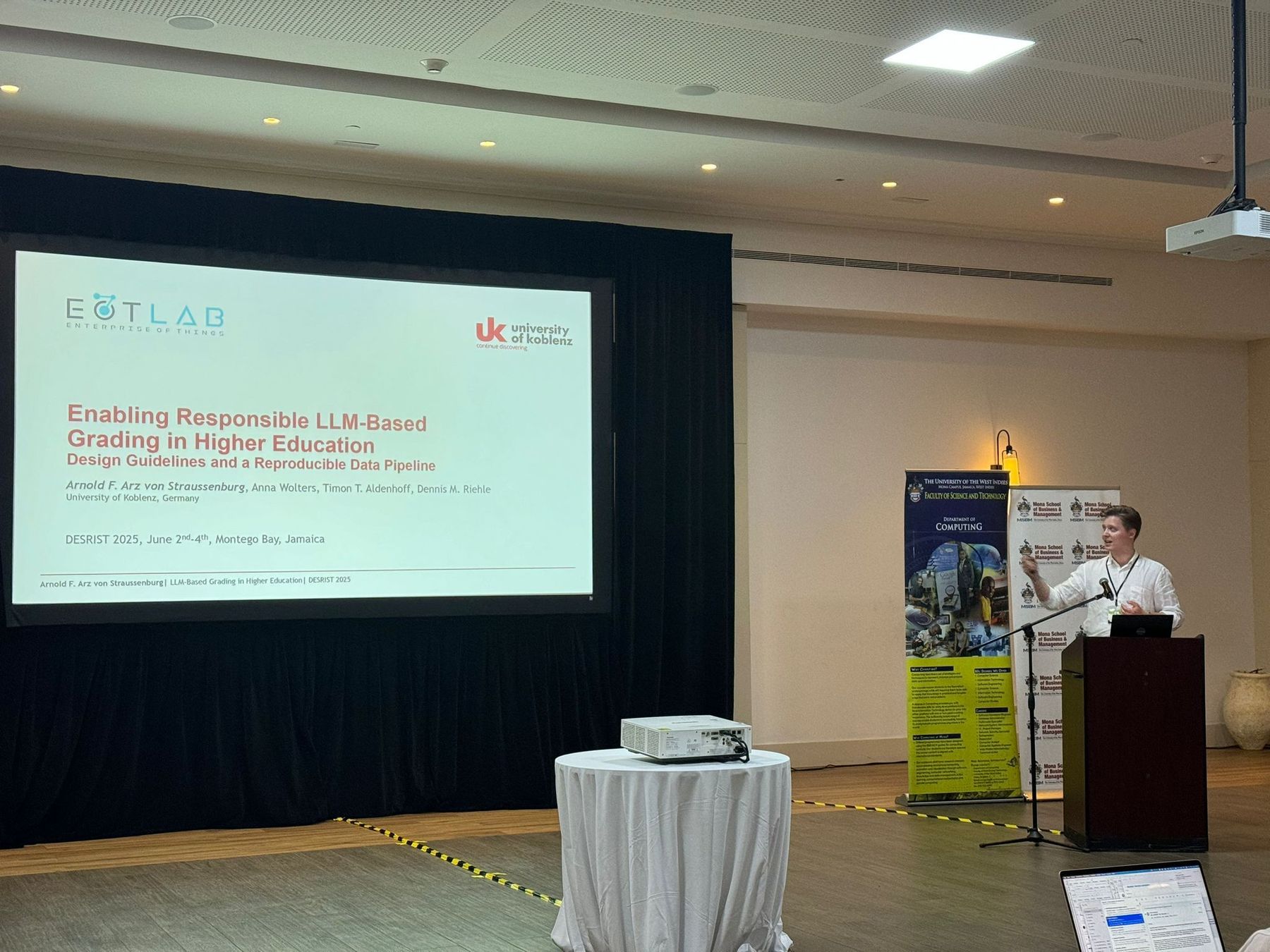
Our research group presented two papers at the 20th International Conference on Design Science Research in Information Systems and Technology (DESRIST 2025) in Montego Bay, Jamaica. The two contributions address current design-oriented research challenges in higher education and Internet-of-Things data platforms, with both papers focusing on the responsible application of large language models in real-world settings.
DESRIST 2025
DESRIST is one of the leading conferences for Design Science Research in Information Systems and Technology. It brings together researchers from around the world to discuss novel artifacts, design knowledge, and methodological advances in the field. The 2025 edition took place in Montego Bay, Jamaica, under the theme "Local Solutions for Global Challenges."
The conference provided an opportunity to discuss both responsible AI in education and robust AI-supported data integration for IoT platforms with the international Design Science Research community.
Paper Abstracts
Enabling Responsible LLM-Based Grading in Higher Education - Design Guidelines and a Reproducible Data Preparation Pipeline
Authors: Arnold F. Arz von Straussenburg, Anna Wolters, Timon T. Aldenhoff and Dennis M. Riehle
This paper addresses the growing demand for accurate, fair, and efficient grading of essay-style assessments in higher education. Building on recent advances in large language models (LLMs), we designed a grading pipeline that integrates institutional requirements with technical safeguards for privacy, explainability, consistency, and fairness.
The proposed approach runs on local infrastructure, applies strict anonymization of student data, and structures grading events in a reproducible format that combines prompts, grading guidelines, student submissions, grader commentary, and final scores. This design supports transparent and consistent evaluation while reducing the risk of bias and protecting sensitive information. Within the project, two local LLMs were fine-tuned using historical course data, and the evaluation showed that they can effectively reproduce original grading decisions while meeting institutional requirements for responsible AI use.
Designing Grammar-Guided LLM Outputs for Open Data Integration - A DSR Approach to IoT Data Platforms
Authors: Dennis M. Riehle, Arnold F. Arz von Straussenburg and Timon T. Aldenhoff
This paper presents a Design Science Research approach for converting unstructured and semi-structured open data into outputs that conform to the OGC SensorThings API. The work is motivated by the growing amount of heterogeneous data in Internet-of-Things environments and the need for reliable ingestion pipelines that produce syntactically valid and interoperable data structures.
The presented artifact applies formalized grammars to LLM-based generation in order to produce valid SensorThings-compatible JSON documents. Early iterations using JSON Schema and Pydantic-based validation already showed the potential of structured output generation, but also highlighted the need for stricter control when processing real-world open data. The evaluation across several open data sources demonstrates that grammar-guided generation reduces malformed and incomplete outputs while remaining flexible enough for different source formats. The findings indicate that this approach can improve the consistency and maintainability of IoT data ingestion pipelines and supports more robust open data integration in sensor-driven platforms.
We thank the DESRIST 2025 organizers and the local hosts in Jamaica for an inspiring conference and valuable discussions around the future of responsible, design-oriented information systems research.