
Posters Presented at ECIS 2026 in Milan, Italy
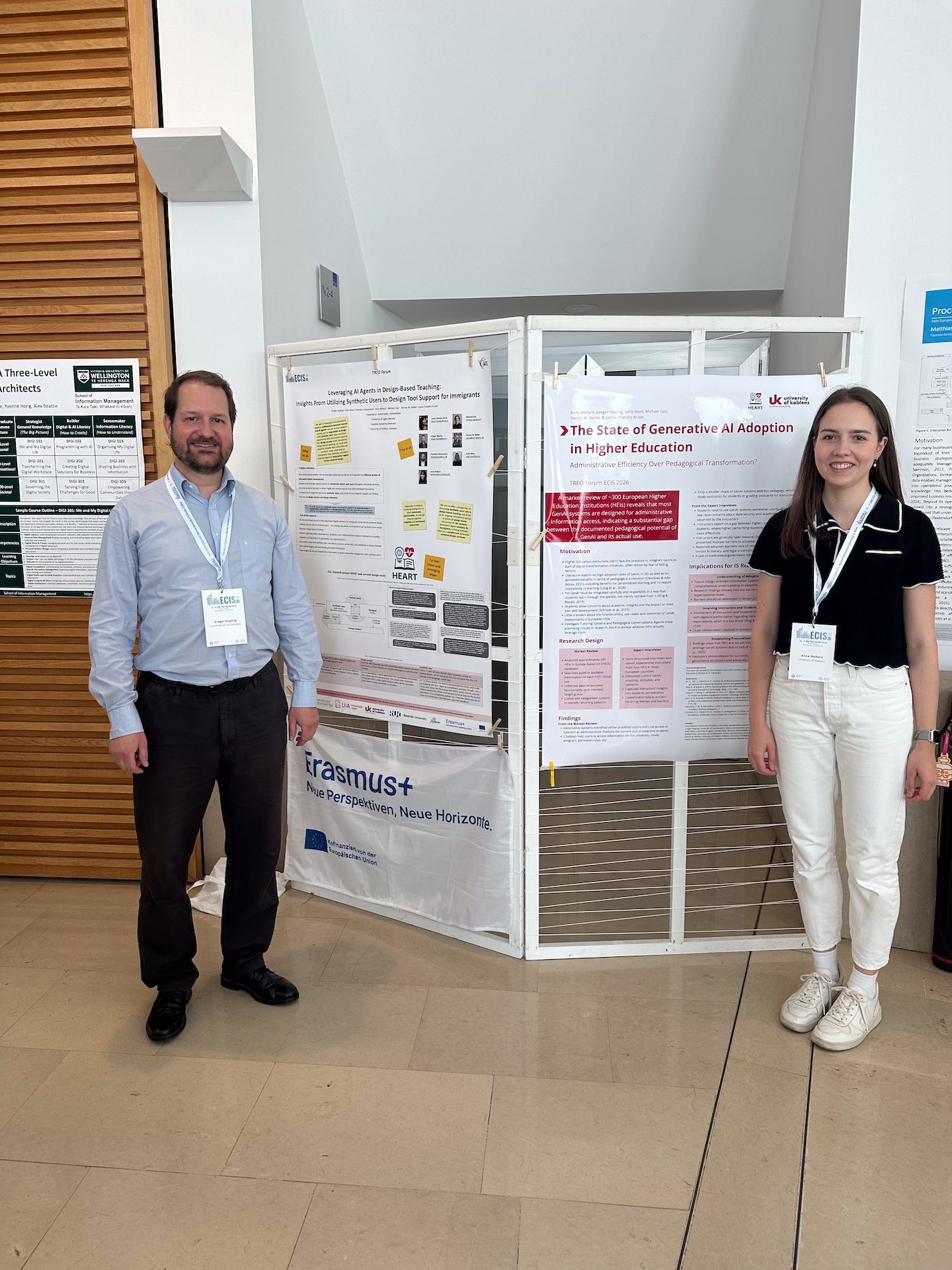
As part of the HEART project, our research group was involved in the presentation of two posters as part of the TREO session at the 34th European Conference on Information System (ECIS) in Milan, Italy. The posters cover the latest research conducted in the HEART project.
ECIS 2026
ECIS is one of the leading conference for Information Systems. It brings together researchers from around the world to discuss latest research findings. The 2026 edition took place in Milan, Italy, under the theme "Reimagining Digital Technology for Business, Management, and Society".
Paper Abstract
The State Of Generative AI Adoption in Higher Education - Administrative Efficiency Over Pedagogical Transformation?
Higher Education Institutions (HEIs) are increasingly integrating Generative Artificial Intelligence (GenAI) systems as part of digital transformation initiatives. Extant research establishes the considerable pedagogical potentials GenAI offers to HEIs. However, a market review of approximately 300 GenAI systems used across HEIs in Europe reveals that most of the systems are not targeting meaningful pedagogical purposes. Rather, the majority are information search chatbots providing information to prospective and current students. In this TREO forum paper, we argue that there is a significant gap between what GenAI systems could offer for teaching and learning and what they are currently used for in HEIs. We provide explanations grounded in the literature and call for the development of GenAI systems that deliver meaningful value to teaching and learning practices in HEIs.
Leveraging AI Agents in Design-Based Teaching: Insights From Utilizing Synthetic Users To Design Tool Support For Immigrants
Conversational agents are increasingly being employed in information system development (ISD) and related disciplines to simulate target user groups during the design process. The so-called synthetic users can serve as collaboration partners capable of helping to shape the various ISD phases, including the evaluation of prototypes. This TREO paper aims to offer a perspective on discussing their role in design-based teaching and draws on an ongoing educational setting in which 23 design teams comprised of 164 students developed digital solutions for immigrants, utilizing synthetic users as a complement to human-centered design methods. We accompanied the students in exploring the role of the diversity of synthetic users, the different roles they assume, and how they contribute to the design process. In our preliminary results, we identify challenges and recognize the need to ensure the responsible use of synthetic users, adhering to ethical boundaries and accounting for their control and validation.
We thank the ECIS 2026 organizers and the local hosts in Milan for an inspiring conference and valuable discussions. We appreciate all the discussion we had during the poster session and would like to thank everyone for their kind feedback and suggestions for future research.